Dedo's Story
Ethnic Cleansing in Foča: Context
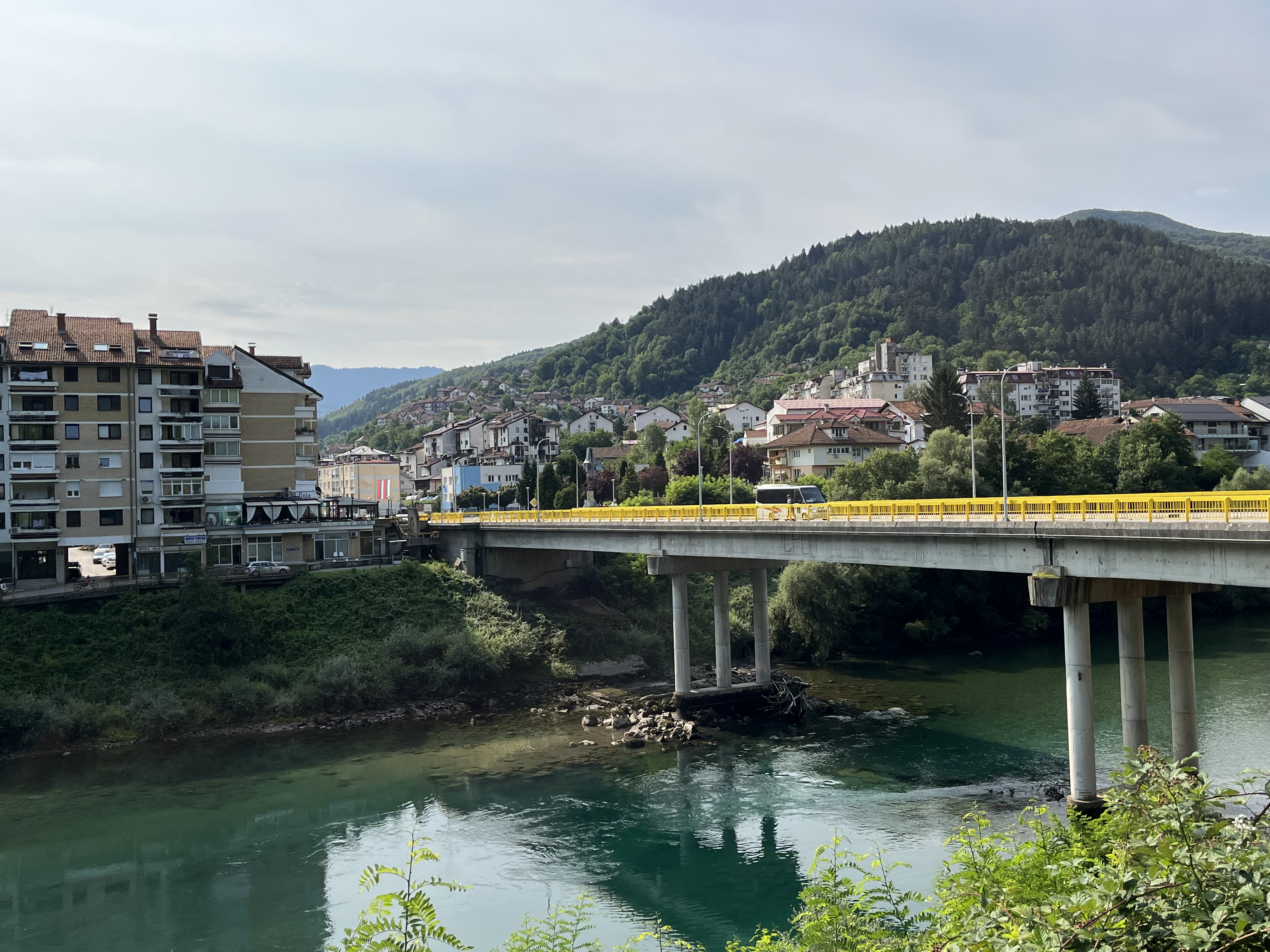
Original image of bridge in Foča, now part of the Republika Srpska region of Bosnia, spanning the turquiose River Drina.
Friend or Foe?
A young Muslim man in his early thirties is awoken in the night by his Christian friend and hurriedly led away from his home into the obscurity of a thick, dark forest. He leaves his wife and infant son behind, not knowing when he will see them again. This young man is fleeing for his life. He fears the very same Christian neighbors who he grew up with in their small town of Focha, Bosnia; who ran up and down fields, jostling each other in a playful game of soccer; who shared textbooks in school and celebrated each other’s holidays. He fears his own townspeople will find him, and execute him, just because he prays in a different way. This young man is Uzeir Trhulj, my great grandfather, whom I have never met yet have heard much about from my mother.
The year is 1942 in the small town of Foca, Bosnia, where Christians and Muslims have peacefully coexisted for centuries. During World War II, the former kingdom of Yugoslavia was under German occupation, and in its center, Bosnia, a militant group of Greek Orthodox Christian Serbs orchestrated the genocide of up to 70,000 Muslim men. When this story, this true story, was recounted to me, I felt shocked. I felt shocked and sad, and, above all, I felt confused that a group of people was capable of creating a divide of such magnitude between themselves and those of another belief, that they could harbor such a hatred of them that they conducted the murder of tens of thousands of their fellow people.
When I heard this family story that has been passed down from my grandfather, to my mother, to me, I was already old enough to realize that there were dark sides to the world’s history, yet this family story has left an imprint on me such that I feel as if I had almost experienced it. I can imagine what it would have been like on that fateful night, with their friend’s urgent knocking on the door, the hush of desperate, serious voices drifting up to my young grandfather’s bedroom, and the darkness and confusion of the night magnifying everyone’s fear.
What is the true reasoning behind such ethnic wars? The essence of all religions that I know of are centered around peaceful coexistence and the spread of kindness. I was aghast that my great grandfather’s own people, his own friends and neighbors, turned against him and went so far as to attempt to kill him. What is it, I wonder, that changed their minds so drastically that they would attempt to murder the very people who were their childhood friends, who celebrated each other’s triumphs and mourned each other’s losses. It seems to me that the line between friend and foe was reversed. I recall my mother telling me the chilling story of how when my grandfather, Uzeir’s son, was in elementary school, the whole class knew that the Christian father of one child had killed the Muslim father of another. And it was never spoken of.
Everyone carries a story within themselves, a closed book that only the people closest to your heart are allowed to read. What stories do you carry within you, that have been passed down from generation to generation, forming a vast library shaping what your inner values are and thus enriching who you are as a person. This family story has shaped my inner values in ways that can only be learned through an experience or personal connection. As a young child, I was taught to be open-minded and very respectful of other religions and cultures. I saw for myself the fatal consequences of elevating one religious group above another and using it as a divisive tool. The world is a rapidly changing place, and we all have the right to safety and opportunities regardless of religion or ethnicity. I have learned that we must accept each other’s differences as the elements which make us all unique human beings, and in unity, and community, help each other to nurture understanding.
Months later, Uzeir reunites with his wife and son in the big city Sarajevo, the capital of Bosnia. They live in Sarajevo, which is under German occupation, for the duration of the Second World War, because there is less religious tension and thus safer for Uzeir and his young family. In the three years that they seek refuge in Sarajevo, my great grandparents hide a Jewish family, saving them from being found by Nazi Germans.