Mama's Story
Siege of Sarajevo: Context
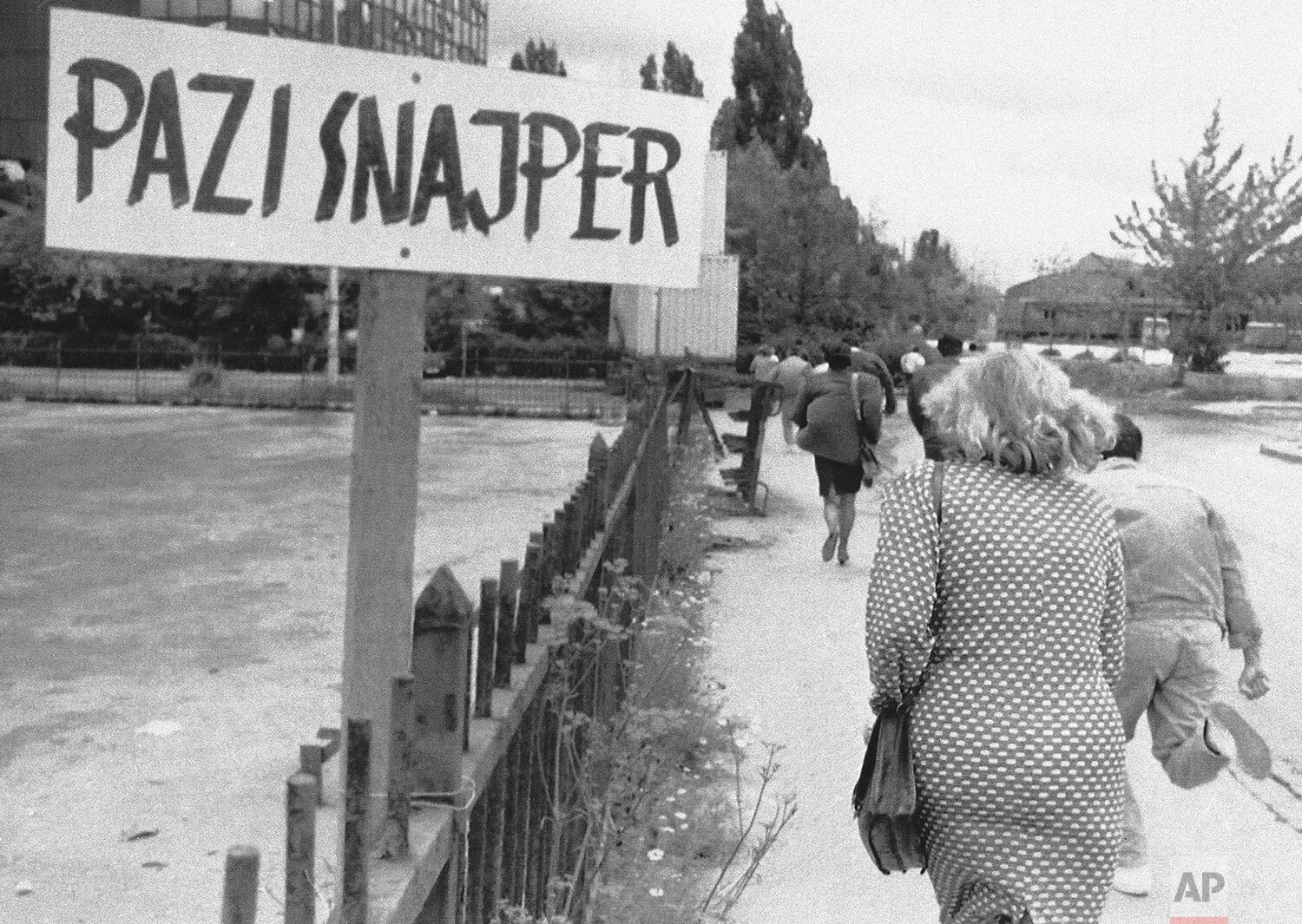
Signs all around the capital city of Sarajevo warn pedestrians to "be careful of sniper fire," speaking to the daily danger of simply walking in the street. Image from AP site archive.
The Siege of Sarajevo was the longest modern siege of a capital in warfare, lasting from April 5, 1992 to February 29, 1996. During this time, civillians experienced constant bombing, shelling, and shooting by snipers while being subject to severe food, water, medicine, and electricity shortages. In response to Bosnia and Herzegoniva declaring independence from Yugoslavia, Bosnian Serbs aiming to create their own state, Republika Srpska, surrounded Sarajevo to force concessions, disrupt government, and terrorize the population.
Memories
A young college student has just finished her grocery shopping at the local market, but on her way home she happens to pass by a bakery that she has never noticed before. She had just turned eighteen. It was her first year of college as a computer science major, and she was at the top of her class.
On the surface, it is a typical day in Sarajevo, with outdoor cafes filled with the familiar chatter of locals sipping their daily coffee and a light fog settling over the rooftops, characteristic of a city located at the bottom of a valley. However, if you pay closer attention, you may pick up that the chatter is in fact quite tense, and the seemingly serene scene is sporadically disturbed by the peppering of gunfire in the distance, accompanied by the near-constant whir of helicopters and war planes overhead.
She pauses and considers buying some extra bread, just in case. On a whim, she steps inside the shop and approaches the counter when… BAM. Where she had been standing mere moments before, a bomb had been dropped from a Serbian airplane into the middle of the bustling street. The blast was blinding and knocked her off of her feet, tossing her into the air before she slumped back onto the hard, unforgiving ground.
One decision, ten steps, and four seconds were the difference between being alive and breathing heavily and being no more. She rushed home, feeling herself enter an out-of-body experience following the intense shock, unable to fully process just how lucky she was to still be alive. Running to the apartment, she announced to her father, shocked into silence, that they must leave immediately, before it became too late to escape.
The sounds of gunfire, airplanes, and the bombs that exploded in their wake were always alarming; however, after months of the siege of Sarajevo, they faded into the background of everyday life, of the struggle to survive and find scraps of normalcy and connection. But that day, the facade of safety was shattered.
Silent, seemingly unable to move, her father stared into space as the life he had spent decades building crumbled around him, leaving his daughter to pack up their documents and most valuable belongings. Managing to herd him out of the house, they raced against time and streets clogged with traffic to get to the airport, meeting their family friend Ika, who brought them their bags that she suddenly realized they had left behind in their desperate escape.
Just as she thought they might still have a chance, the airport was empty save for teeming crowds of armed soldiers in olive green uniform as war planes took off with a whoosh outside. The airport had been occupied by Serb forces, and they were not letting anyone but the military leave or enter the city by sky. The young woman was crying, desperate, sure now that they had no chance of escape, no chance of reuniting with her mother and nine-year-old brother who had fled five weeks earlier. Crushed, she sobbed uncontrollably in this airport where there were more weapons than there were people.
Even as she retells her experiences today, she still seems slightly bewildered by what happened next. In a final attempt to escape, she ran up to a young Serb pilot, desperately pleading with him through her tears to just let her and her father get to Belgrade, the capital of Serbia. She hoped that they would be safe there among her mother’s side of the family.
He quietly said that he was about to fly out to Belgrade on a routine trip, and he could make room for them in his airplane. This nameless man, on this day that was random for every other person in the world but was the day that my mother’s entire life turned upside down, gave them a lifeline. And without his moment of unexplained kindness for a stranger, I genuinely do not know where my mother would be today.